


Choosing a Payment Gateway Should Feel Simple, Not Overwhelming

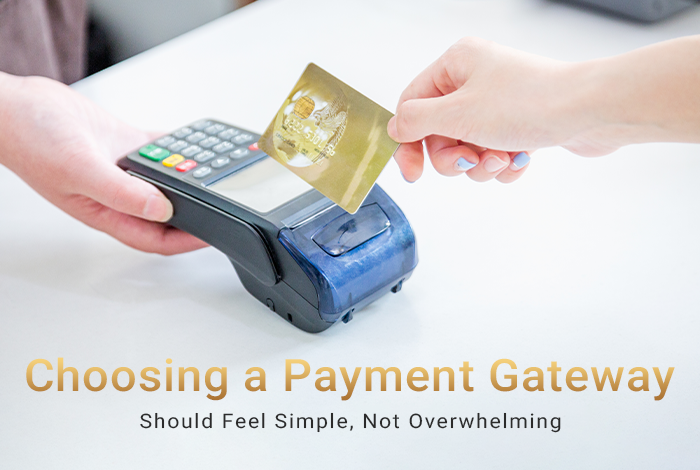
Almost every business owner has to deal with such issues at some point. You’re adding online payments, improving the checkout process, or giving customers more ways to pay, and all of a sudden you have to deal with terms like “payment gateway,” “processor,” “merchant account,” and “APIs” that you don’t know. What should be an effortless choice starts to seem like a lot of work. Most business owners would rather not learn how to use payment technology. All they want is for payments to go through without any problems.
That’s how a payment gateway should feel when it’s set up right.
What a payment gateway really does
A payment gateway is the technology that safely sends payment information from your customer to the bank and then back to you with a yes or no. It connects your website or point-of-sale system, your customer’s card or digital wallet, and the banks that approve the transaction in a way that you can’t see. The payment gateway becomes less important when everything is working right. Customers make purchases without hesitation, and businesses receive payments immediately, without any issues or delays.
It doesn’t take long for people to notice when a gateway isn’t working right. Customers lose faith when you want them to feel safe, transactions fail, and checkout takes too long.
Why the Right Payment Gateway Is More Important Than You Think
The payment gateway you use has a direct effect on how your customers feel about your business. A smooth, fast, and reliable gateway makes it easy to check out, especially on mobile devices where people don’t have much time to spare. Even if everything else about your product or service is excellent, a slow or broken gateway can cause problems that make people leave their carts and lose sales.
Your gateway affects more than just the customer experience; it also affects how well your business runs behind the scenes. Your payment gateway’s compatibility with your setup affects your reports’ accuracy, your ability to reconcile accounts, your fraud protection, and your systems’ cooperation.
Why many businesses choose the wrong payment gateway
Most businesses don’t mean to pick the wrong payment gateway. It happens a lot because the gateway came with a processor, was recommended by a developer years ago, or was chosen just because it was easy to set up. It might have made sense back then. But as businesses grow, add new ways to sell things, or change how they take payments, that first gateway can become a problem without anyone noticing.
A new business may not be able to use the same strategies as a growing eCommerce brand, a subscription-based business, or a service provider that handles high-ticket transactions. Without regular reviews, businesses end up changing how they work to fit with old technology instead of the other way around.
The Trade-Offs That Many Payment Gateways Don’t Show
Not every payment gateway is made to be flexible. Some people put ease of setup first and long-term control second. Some are very secure but don’t let you customize or report on them. In some cases, gateways lock businesses into certain processors, which makes it harder to change rates or services later.
At first, these trade-offs are not always clear. They show up slowly as companies try to grow, add new tools, or improve the checkout process. When the frustration starts to show, switching seems scary, even if it’s necessary.
How the Merchant Advocacy Helps Companies Make Better Choices
The Merchant Advocacy doesn’t push any one payment gateway. Instead, it’s about knowing how your business takes payments now and how it will do so in the future. A favorable review looks at how your gateway works with your systems, how it helps your customers, and whether it lets you grow without making things more complicated.
Sometimes the best thing to do is to make what you already have better. Sometimes, it’s finding a gateway that better helps you reach your goals. The process is about being clear and on the same page, not about pressure.
No more headaches with security and compliance
One of the most important things a payment gateway does is keep your information safe, but it shouldn’t be too hard. A properly set up gateway protects sensitive data with modern encryption and tokenization while also meeting PCI compliance requirements in a way that lowers the risk for your business. When security is set up right, it works quietly in the background to keep you and your customers safe without slowing down transactions.
You can focus on growth instead of worrying about security holes if you trust your payment gateway.
When to Look at Your Payment Gateway Again
Your payment gateway may be holding you back if customers are having trouble checking out, your reports don’t seem complete, or you feel like you can’t accept payments in enough ways. Even though payment technology changes quickly, many businesses haven’t looked at their gateway in years. A quick review can find ways to boost performance, flexibility, and customer satisfaction without causing too much trouble.
A Smarter Way to Make Payments Easy
Your payment gateway should help your business, not make it harder. Payments are easy for customers and easier for your team to handle when the right systems are in place. You don’t have to be an expert on payments to make smart choices. You just need someone who knows the area and wants what’s best for you to help you.
Go to The Merchant Advocacy to check out your current payment gateway and make sure it’s helping your business, not hurting it.